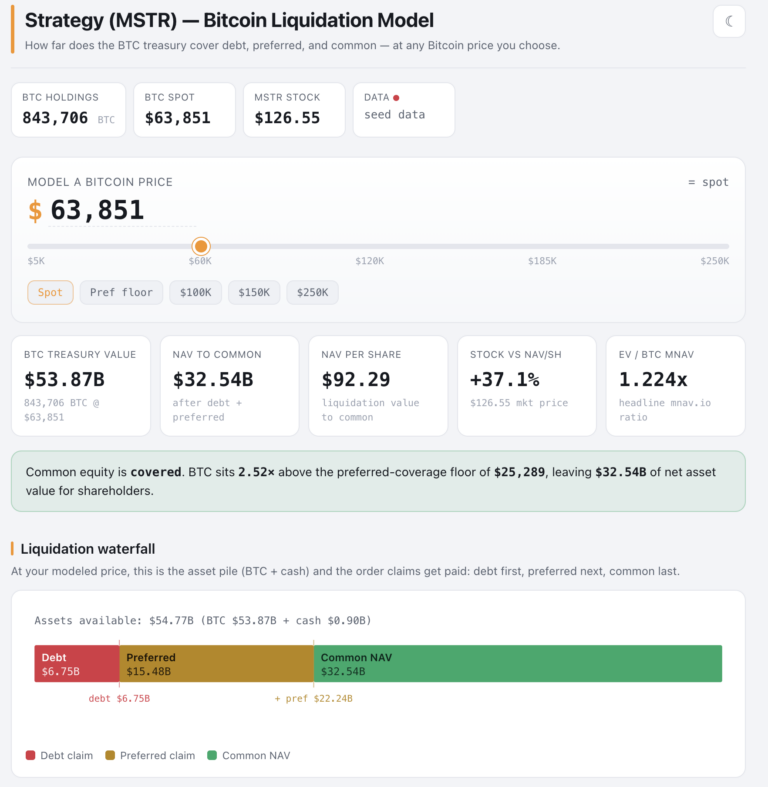
From Bitcoin Treasury Company to Bitcoin HoldCo
The Bitcoin treasury company arrived as a public-markets vehicle before the ETFs did, and the working assumption at the time was that they served as a de facto proxy for Bitcoin investment. They provided a mechanism for garnering exposure that was otherwise out-of-reach:
- Institutions who were precluded from investing alternative assets
- Savings within retirement accounts
- Anyone who wanted exposure without the custody headaches
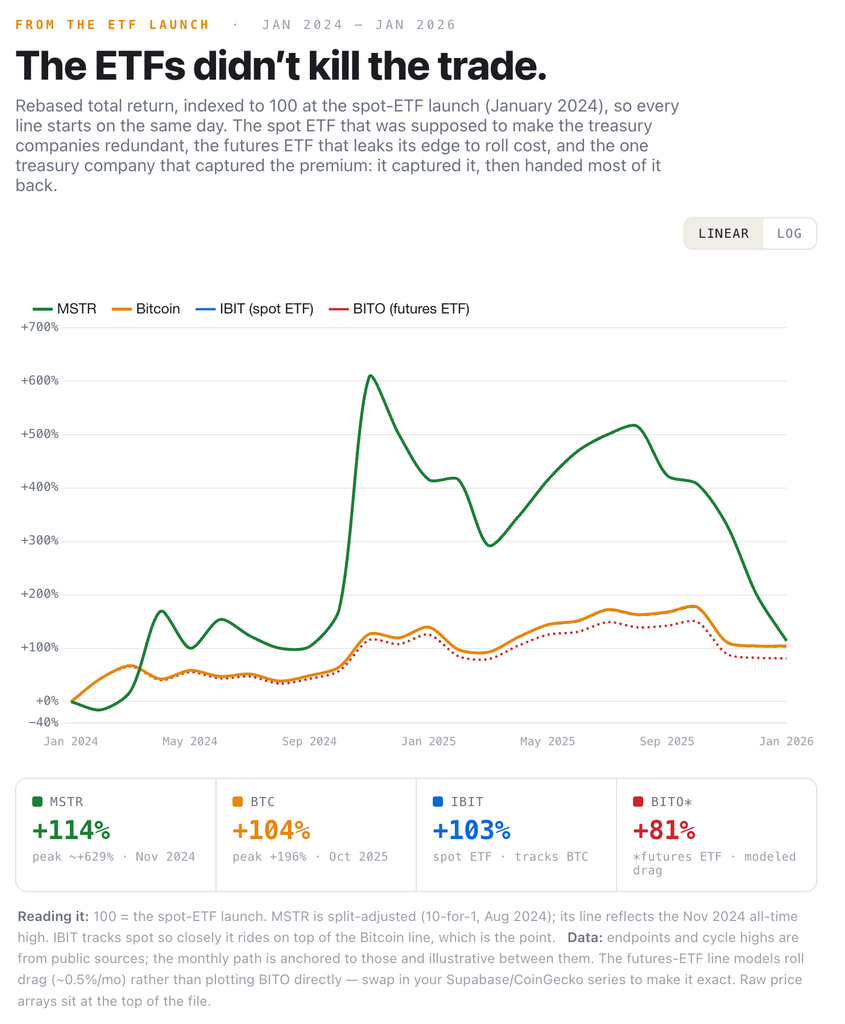
When the spot ETFs finally were cleared in early 2024, the expectation was that they would make the treasury companies redundant: a listed wrapper around coins, only cheaper, cleaner, and without the corporate overhead. The whole reason to hold MSTR instead of a Bitcoin fund was supposed to evaporate the moment spot ETFs were approved.
It didn’t, and this shouldn’t have been a surprise.
One of the reasons it wasn’t, at least for me here in Canada, was that spot ETFs for Bitcoin and Ethereum were a reality since 2021, three years before the US approvals, and Canadian investors were still paying premiums to own Bitcoin treasury companies even though they already had the ability to buy ETF substitutes.
So some other market driver than an equity-wrapper for Bitcoin had to be behind the ascent of Bitcoin Treasury Companies. There have been various descriptors of what that was, and we’ll review them briefly here – but this article posits that there is another stage, beyond the Bitcoin TC, that will utilize these BTC-heavy balance sheets in somewhat novel manner, and that the companies who see the opportunity and build a pipeline around it will be setting themselves up for mult-cycle primacy.
Through the last cycle Strategy outran the ETFs by a wide margin, the spot funds tracked more or less at par with Bitcoin itself (which is exactly what they were engineered to do), and the futures-based ETF products bled carry the entire way, lagging by as much as five percent a month in the worst stretches. The instrument that was supposed to be killed by the ETFs spent the cycle beating them.
Two things became clear by the end of Cycle 4, though, and they’re harsh reality checks for the companies that spent 2024 and 2025 cloning the MSTR playbook.
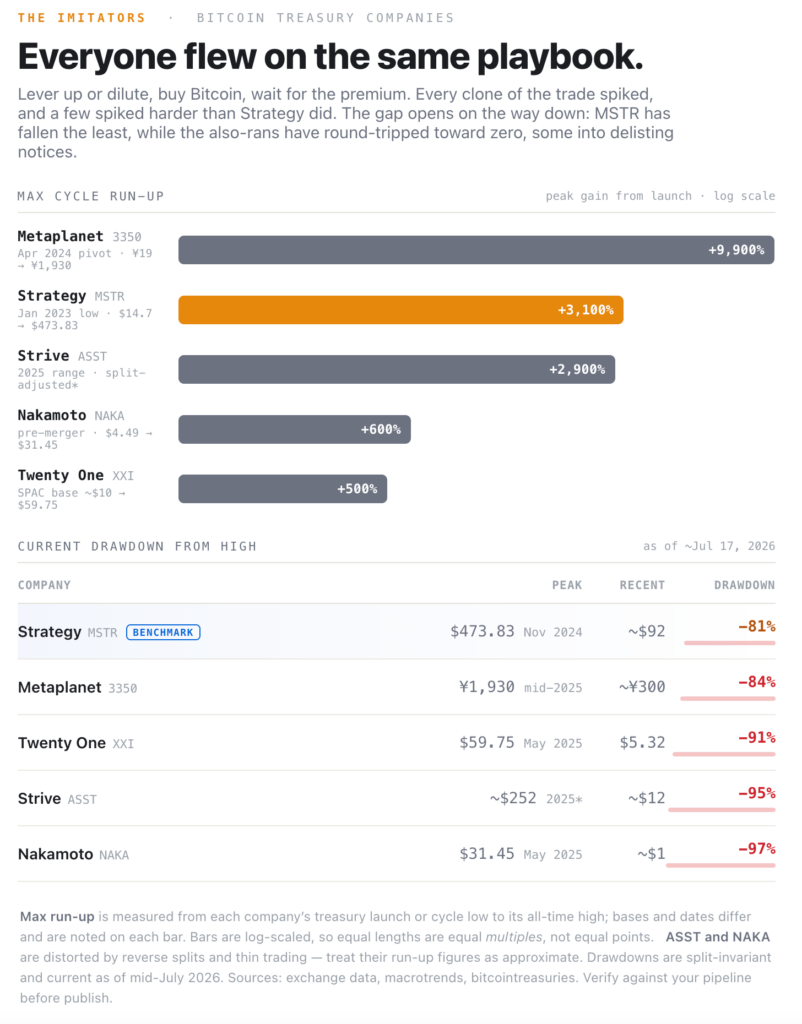
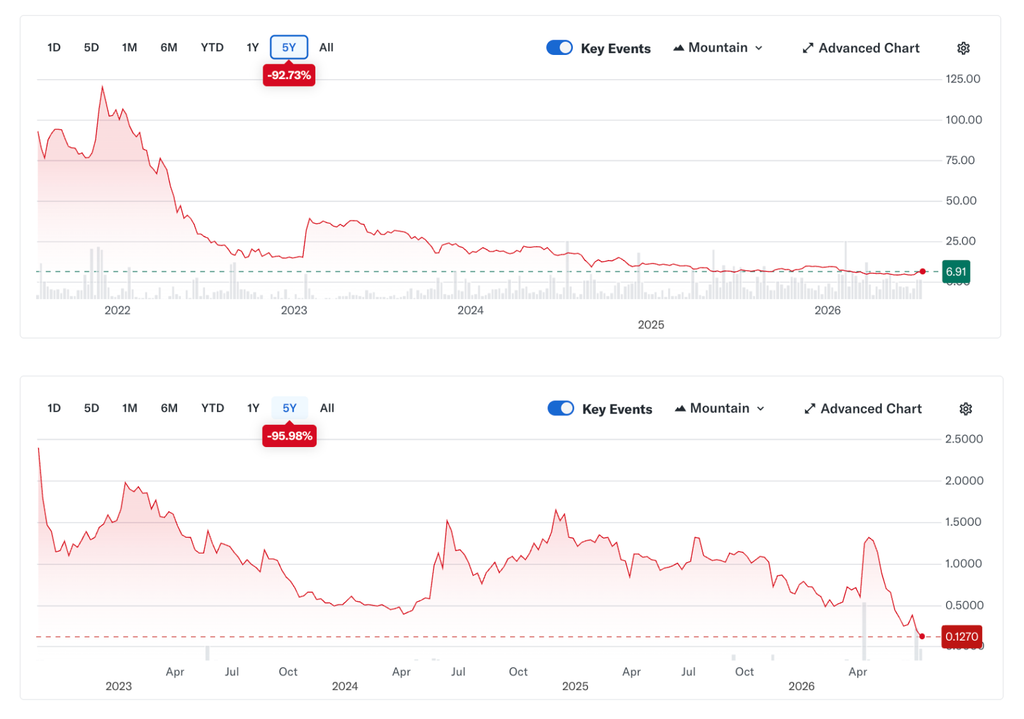
The first is that the extra torque afforded as an mNAV premium during the bull cycle cut both ways, and became a pronounced discount on the way down. As we can see below, the Bitcoin TC’s as a cohort have been annihilated in what was otherwise a milder bear cycle for BTC itself (roughtly a 50%-55% drawdown from all-time highs).
The other is that there was a huge differential between the TC front-runners and also-rans, who lagged badly in terms of performance, and crashed deeper than both Bitcoin and the sector leaders did on the way down.
Every cycle has a theme, and the theme rotates from one cycle to the next.
What worked as a standalone thesis in one cycle becomes table stakes in the next and quite possibly a drag in the one after that.
The treasury companies that intend to be around for the next cycle have to evolve past the theme and the narrative that defined them, which brings us to a rather awkward observation: these businesses need to have, you know, actual businesses. If for not other reason than to throw off enough cash to keep the lights on and give them a buffer that enables them to survive the next bear without becoming forced sellers of their BTC.
Strategy at least understood the direction of travel, and built structured credit products around the treasury – converts, preferreds, an actual capital-markets operation. They’ve taken a lot of criticism from the “not real Bitcoin” crowd, but recent events have shown that they’re weathering this bear market relatively unscathed in terms of forced liquidations.
(Contrast with many miners throughout the 2021-22 bear and some of the lower-tier treasury companies now, many of whom have had to liquidate a majority, if not all of their Bitcoin).
But what Strategy never did was synthesize their legacy data-analytics business into any of their Bitcoin-financialization engine. For years I would write my own pet thesis for Microstrategy (back when they were called that): “Microstrategy is going to become the Microsoft of micropayments”.
It sounded sexy. But it also never happened. Not even close.
There was probably no product-market fit there to begin with, which is its own lesson: any operating business (or businesses) strapped inside a Bitcoin Treasury Harness have to do one very important thing: throw off cash.
Strategy’s data analytics business has been lurching along at break-even for about a decade with a run rate at around half-a-billion per year. It probably keeps the lights on for the entire enterprise, but not much more beyond that. There have been times I’ve half-expected them to announce they’ve sold it off, to fund more Bitcoin purchases or cover their prefs.
The harder truth behind all of this is that “Bitcoin-only” businesses are hard, and it they get more difficult as retail leaves.
Retail is gone, actually. They will not be back for a long, long time.
Somebody asked me a while back at what price retail comes back. My honest answer: somewhere north of a million dollars a coin (and probably showing up to ring the bell at the top of whatever cycle produces that price).
It doesn’t matter too much, because retail doesn’t drive valuations, they’re a lagging indicator, at times by an entire cycle. But what it does mean is that “Bitcoin only” is a tough grind and most Bitcoin-only shops are retail-facing.
Even the miners aren’t Bitcoin only anymore, as nearly all of them have morphed into HPC businesses.
That is the backdrop. A cohort of companies with no more mNAV pricing power (for lack of a cleaner term for it), sitting on the one thing that did survive the cycle intact: a pile of Bitcoin.
What is true is that Bitcoin has, in the institutional sense, made it into legitimacy. This stuff is no-longer a speculative moonshot that could conceivably go to zero but rather part of the plumbing now. Everybody knows that there is a global, monetary reset coming, and Bitcoin, along with Stablecoins and yes, even cryptos, and CBDCs are all going to be a part of it).
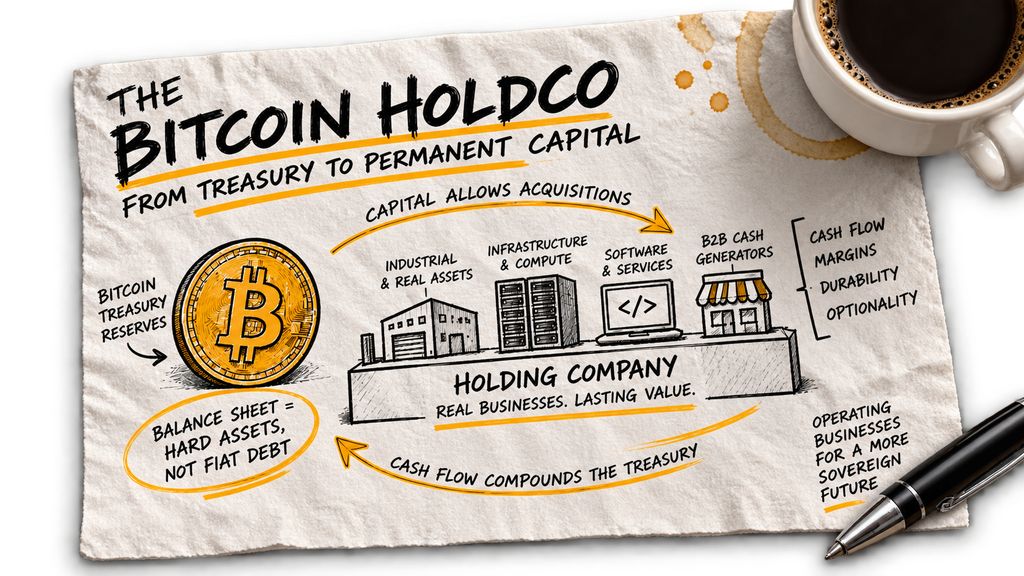
What that means is those accumulated Bitcoin treasuries can now be transformed into something more durable than a premium that only one company ever really earned.
They can become engines of permanent capital.
What a HoldCo Actually Is
I have been studying conglomerates and holding companies for longer than the thirteen years I have been studying Bitcoin, and the same patterns keep surfacing in the ones that endure. A holdco, stripped to its definition, is a business whose business is owning other businesses: through outright ownership, majority stakes, and in some cases, minority positions.
That definition also covers a lot of wreckage, so the distinction that matters is which kind of holdco we are talking about. The hodge-podge conglomerates of the 1960s Go-Go Era bought diversified, unrelated holdings for no reason more coherent than that they could, using their own inflated stock as acquisition currency and little else underneath it. The names from that era are mostly footnotes now.
The holdcos that endured across decades bear names you recognize, and they share one ingredient that the wreckage lacked: a float, or some other source of permanent capital.
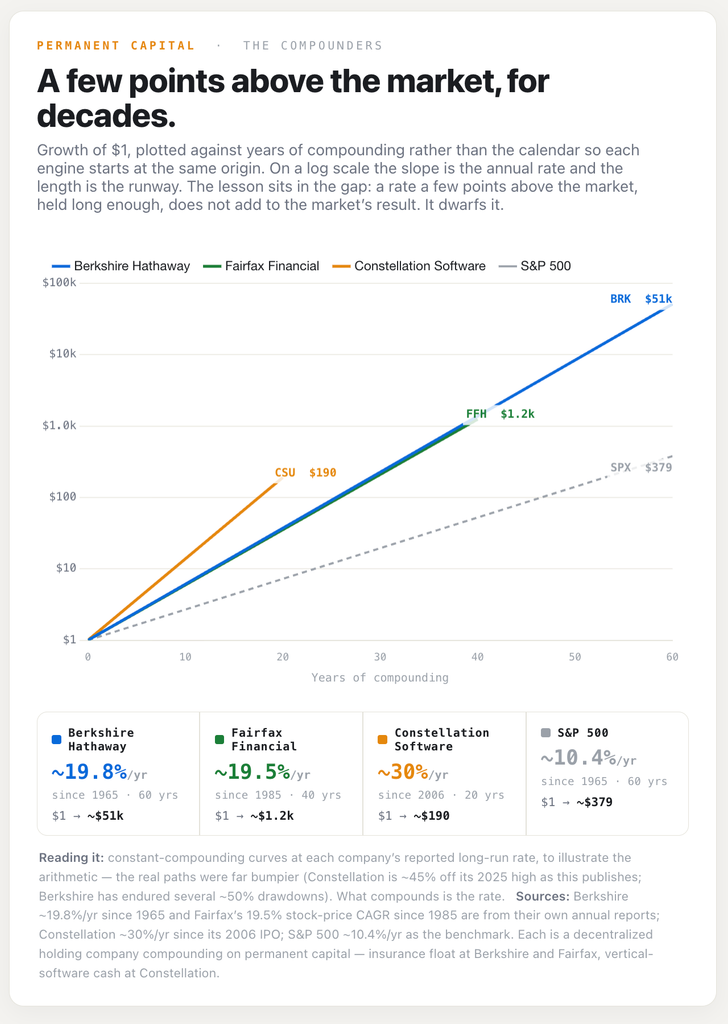
Berkshire ran on insurance float. Fairfax and Markel on the same. Constellation Software on the relentless free cash flow of hundreds of boring vertical-market software businesses. The mechanism differs, but the ingredient is constant: one or more flywheels constructed on a pool of capital that stays in the business, at low or negative cost, that management can deploy over and over – and it allowed them to outrun their benchmarks.
And for every one of those, there is a gaggle of wannabes, the ones that bill themselves as the modern-day Buffett or Berkshires of the twenty-first century, and go on to accomplish little except the vaporization of enormous amounts of shareholder equity. I have studied those too. The common thread to some extent is what they’re doing wrong (like consistently overpaying for low quality businesses). But it is even moreso a case of something they are missing. They have no float. No flywheel, no engine of permanent capital, nothing that lets the machine turn without constantly feeding it fresh equity – either through capital injections or relentless share issues.
A Bitcoin treasury, handled correctly, can be that permanent-capital base and a company employing it effectively could exceed their own benchmark – in this case, not the S&P500 but the CAGR of Bitcoin itself.
Which sets up the part everyone gets backwards.
The Engine is The Float, Not the Coins
The secret sauce in what I’m suggesting isn’t actually the Bitcoin, per se as much as what we do with it. What we really need is the float, and there are two kinds worth separating.
Accumulated float comes from accretive acquisitions: targeting the right companies, buying them at the right price, and then executing well enough to at least hold and ideally grow the income streams you acquired. This is where most Berkshire imitators die. They buy marginal businesses at credulous multiples and then tank them. These names wind up with stock charts that look like memecoins: a vertical launch, a lower high, and a long grinding bleed to nothing.
The holdcos that get this right are, as a rule, decentralized to the point of near-invisibility, and the businesses they own are stultifyingly unglamorous. That is a feature. Boring, cash-generative, hard-to-disrupt businesses throw off excess cash, and that cash is what compounds into accumulated float.
Structural float is the rarer animal. It comes from a genuine alignment of the stars: a pool of insurance premiums that has to be held against future claims yet remains investable in the meantime, or an entity sitting on a natural or quasi-monopoly with pricing power to match.
Or, now, perhaps, a pile of Bitcoin.
A pile of Bitcoin can behave like permanent capital, but there is a right way and a wrong way to do it.
The elevator pitch is that companies can collateralize their BTC treasuries and use the proceeds to buy accretive businesses or cash flows (royalties, etc).
They can then use the FCF from the acquired assets to unencumber their collateral, then they rinse, lather, repeat.
That’s it.
However the details could fill volumes. And if I’m right, someday they will.
For starters, a company like Strategy could issue unsecured, long-dated convertibles.
Smaller companies, or private ones may have to pledge BTC, this changes the risk model substantially, but under the right circumstances, for the right deals at the right time, they can work.
With these caveats in place, the flywheel condition is straightforward, and it all comes down to one number – a single variable – rather than any elaborate formula. The big problem here is nobody knows what this number is so anybody running the playbook will have to develop their own thesis around what it is (said differently: their best guess).
It’s Bitcoin’s medium-term compounding rate: the CAGR.
We take number and put it up against the all-in cost of the capital (CoC) you raise against it as another.
Three scenarios follow.
Scenario 1) BTC CAGR is higher than the cost-of-capital
If Bitcoin compounds faster than the cost of the capital raised against it, the treasury funds your acquisitions and your reaccumulation for less than it grows, and the flywheel turns under its own power.
Scenario 2) BTC CAGR ~ CoC
If the two rates are roughly equal, you still come out ahead: the carry nets to about zero and the businesses you acquire are, in effect, financed by Bitcoin’s own appreciation – a free acquisition engine.
Senario 3) BTC CAGR < CoC
And if Bitcoin compounds more slowly than your borrowing cost, which is entirely possible across a long flat stretch, the model does not necessarily break, but it now depends on the accumulation gear doing its job: the cash flows from the businesses you own have to cover the gap and keep buying coins.
It is important to stress that buying marginal businesses at excessive valuations leads to failure across all three scenarios. A Bitcoin treasury company would have to assemble the capital allocation expertise to run this playbook.
Operating businesses that already undertake acquisitions and happen to have Bitcoin treasuries would appear to be better poised to run this playbook (Block, TSLA/SPCX, GLXY).
The best case is the two-dimensional flywheel: Bitcoin’s compounding clears the cost of capital and the acquired subsidiaries throw off positive free cash flow. Then both gears turn at once. The treasury appreciates while the businesses fund more of everything, including more treasury.
The Dawn of the Bitcoin HoldCo
The mNAV premium is not going to cut it over the next cycle. It might still work for Strategy, and realistically for Strategy more or less alone, on a path toward becoming something closer to Business Development Companies – regulated-adjacent credit structures, banks in all but name, monetizing Bitcoin’s volatility rather than simply holding coins.1
If the premium is played out for everyone but the first mover, the narrative and the companies both have to evolve.
Monetizing the treasury through low-cost, long-dated leverage in order to buy productive businesses is the natural, sustainable next step, and unlike the premium, it is available to more than one company.
The targets worth looking at share a short list of characteristics:
Product-market fit has to be a non-issue:
No startups, no pre-revenue moonshots, nothing that requires a thesis about the future to justify the present cash flow. We want companies that stopped thinking about product-market fit years or even decades ago. Companies that already know exactly what business they are in and are simply doing that. This is not venture capital, and it certainly isn’t angel investing.
The targets have to be profitable in the unspectacular, tangible sense: real free cash flow and retained earnings, not pro-forma adjusted mythology.
And they have to be sustainable, which is where most failed holdcos actually die. They buy businesses with no staying power – companies being disrupted out of existence, or running on margins too thin to survive during the downturns, or so capital-intensive that the cash flow never reaches the parent. Durability is the name of the game and Lindy-Effect is one of our filters.
Bonus points for two adjacent cases:
Companies that already accept Bitcoin or other crypto and reflexively liquidate it to fiat: the low-hanging fruit is to convert whatever comes in to BTC and sweep it into the treasury instead.
And companies that do not accept crypto but easily could: hang out the shingle and do the same thing. Every such subsidiary quietly turns into another accumulation gear: web hosting companies, server farms, e-commerce, any place the business already has an “Other payment methods” with a “PayPal” button, add a “Pay with Crypto” option.
The Mechanics
The clearest way to show what this looks like is to run the numbers on a couple of experimental case studies using real, public companies. This way the math is concrete rather than hypothetical.
What follows are illustrative worked examples of the structure, not acquisition recommendations and not a claim that anyone is buying these names. They are simply the cleanest available specimens of the mechanic.
A durable software cash machine — the PagerDuty (PD) shape. As of mid-2026, PD trades around $10 a share, revenue runs a little under half a billion, and the business converted roughly $103 million of that into free cash flow last fiscal year at gross margins in the mid-80s. The stock has roughly halved over the trailing year, which makes the take-private arithmetic almost embarrassingly easy on paper.
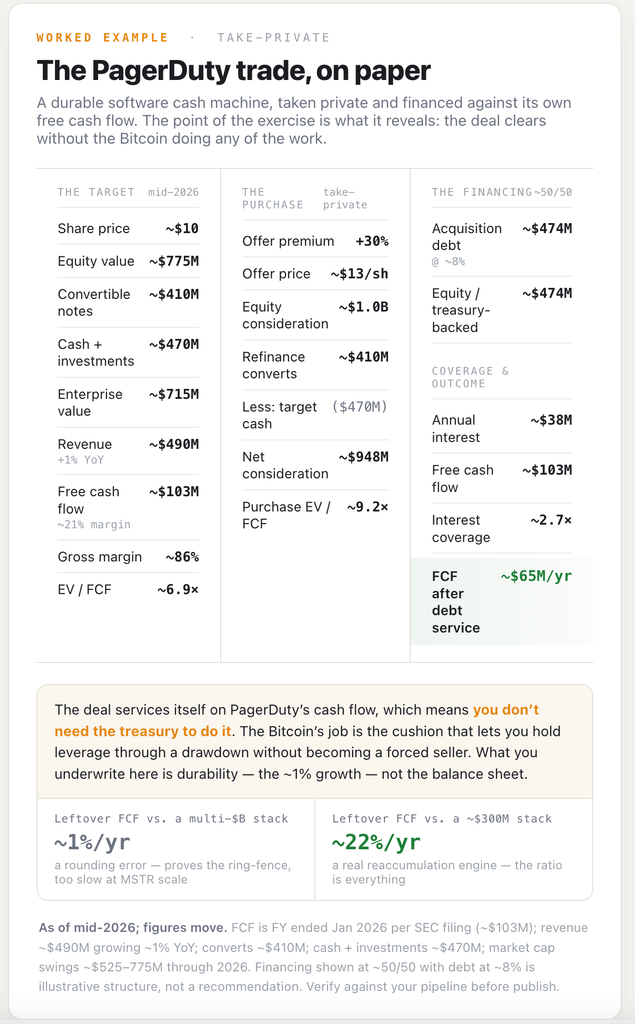
Take it private at a 30-percent premium and fund about half the purchase with acquisition debt at high-single-digit rates. Interest lands somewhere in the low tens of millions a year against a hundred-million-dollar cash flow: coverage in the two-to-three-times range, comfortable, with a meaningful stream left over after debt service. It works.
Two findings shake out of that:
First, the leftover cash flow – call it the low tens of millions a year – is a trickle against a multi-billion-dollar Bitcoin stack. It proves the ring-fence works, but it is far too slow to matter as a reaccumulation engine at Strategy scale.
Second, you don’t actually need the Bitcoin layer to do this deal at all. It is a clean leveraged buyout on its own cash flows.
Which forces a real question here: is the Bitcoin accretive to the acquisition engine, or is the acquisition quietly subsidizing a Bitcoin bet?
The strongest honest framing is neither. The operating cash flow is the cushion that lets you hold Bitcoin leverage through a drawdown without becoming a forced seller. That is a real and valuable function. It is just not the magic the pitch decks imply.
In terms of the first point: we wouldn’t look at whether Strategy owning PagerDuty moves the needle in aggregate for Strategy – how much Bitcoin did they have to collateralize in order to do it? Probably about $1B. Which pencils out to a 9% ROI – against converts that priced at (2%?). Rinse, lather… repeat.
The remaining risk in a name like this is not the balance sheet. It is the roughly one-percent revenue growth, which means you are underwriting durability rather than growth, and you had better have a clear view of what kills the business (in this case, a hyperscaler bundling the same functionality for free). Underwrite the moat, not the story.
A native-float generator — the Betterware (BWMX) shape. More interesting than the software case, because it stacks two capital engines instead of one. A direct-to-consumer operator with negative working capital collects cash from customers before it has to pay its suppliers, which is a float-like property in its own right: customer money funds operations in the gap. Acquire a business that generates its own float with a treasury that is supposed to serve as float, and you are running two engines with different risk profiles at once. The concentration risk (single brand, single geography) is the thing to price, and to say out loud.

A private SMB operator — the retail-scale proof. Drop the whole thesis to the level of a small private company and the instruments change but the playbook survives. A private operator with a few million in recurring revenue cannot issue a convertible: no public equity, no float for arbitrage desks to short against, no implied-volatility surface to sell. The convert is simply off the table, because of scale, not because of Bitcoin.
But at that scale Bitcoin does something arguably more useful. It becomes the cleanest source-of-funds collateral a lender could ask for. When a small operator buys a smaller target, the bank underwrites the acquisition on the target’s cash flows plus the buyer’s own revenue; the equity slice just needs to come from somewhere clean and liquid.
A loan against Bitcoin is pristine from the lender’s side: liquid around the clock, marked continuously, easier to underwrite against than illiquid real estate or a personal guarantee. Keep the LTV conservative, let the target’s cash flow cover service, and you have run the exact institutional play at a thousandth of the size, with a bank loan standing in for the convert.
We’ve looked at ourselves at my main business, and I’m pleased to report that in conversations around acquisitions, when a Canadian bank asks where “the source of capital” for our equity stake is coming from, and we told them it was from collateralizing our BTC treasury, the response was “that’s really cool”. A few years ago it would have been “whoah, let’s slow down”.
As we can see from our hypotheticals: the ratio and matching scales is where the magic happens. The leftover cash flow that was a rounding error against a multi-billion-dollar stack becomes a twenty-percent-a-year reaccumulation engine against a three-hundred-million-dollar one.
The smaller the Bitcoin position relative to the operating cash flow, the more every part of this actually moves the needle. The sweet spot is not maximum scale. It is the mid-sized treasury where the operating businesses are large relative to the coins, big enough to carry sensible leverage, small enough that a hundred-million-dollar cash flow visibly changes the trajectory.
The corollary is worth considering: the better the operating business, the more the whole entity is really a holdco that happens to own some Bitcoin, rather than a Bitcoin treasury that happens to own businesses.
If I were to make the point of this article in one sentence it would be this: Bitcoin Treasury companies are not viable business models unto themselves. Bitcoin treasuries enabling holdcos and opcos are.
Margin of Safety
Seth Klarman titled his book Margin of Safety for a reason, and it’s a key tenet of the value investing greats. His book is out-of-print now, and orginal copies now trade north of $1,000. People sell PDF scans of it for $50 on eBay.
The idea is old and simple: structure your deals so that you can survive being wrong, because you will be wrong.
Assume the four-year cycle is with us a while longer. Then assume it isn’t, because counter-cyclical bears happen inside up-cycles too. we have to build the margin of safety so the structure holds through a prolonged flat-to-down stretch, not just a textbook cyclical dip.
In the ordinary case, the acquired businesses carry you. Their cash flow services the debt and
keeps buying BTC straight through the drawdown, which is the entire reason to own operating businesses rather than a static pile.
The worst case is liquidation of the collateral, and here’s how that plays out against the two structures we’ve posited here.
In an overcollateralized, non-recourse secured Bitcoin loan, a liquidation is survivable in a specific and almost counterintuitive way. When the collateral is seized, the debt is extinguished against it, you recover whatever residual coins sit above the liquidation threshold, and you still own the operating business. Except now it’s completely unencumbered.
You could even reframe it mentally as a forward sale: treat the seized Bitcoin as coins you effectively sold at the liquidation price, and now you can deploy all of the operating cash flow at buying replacements on the open market, at what are by definition resale levels.
In the case of the unsecured convertible, the outcome isn’t as clean.
If you funded with converts, a Bitcoin drawdown extinguishes nothing. You still owe the principal on the date it comes due, drawdown or no drawdown.
The structure that gives you the clean, ring-fenced liquidation (secured, low-LTV, non-recourse) is the one that carries a margin-call tripwire, and the structure that removes the tripwire (the unsecured convert) is the one where a bad drawdown leaves the debt fully intact.
You do not get both. You choose which failure mode you would rather own – forced liquidation, or a maturity wall you have to refinance into a bad tape – and you size accordingly.
The difference in interest rates between the two options is also enormous: 14%+ in the case of secured, non-recourse) vs sub-1% for the convertibles.
Another important ratio that the “lever up for torque” crowd skips: LTV is not the risk number. Distance-to-liquidation is.
Liquidation triggers above your origination LTV, and many BTC-backed lenders sit that trigger somewhere in the low-to-mid 80s percent, though the exact band is provider-dependent and worth confirming per lender.
Originate at 50 percent and Bitcoin has to fall roughly 40 percent before you are in trouble. Try to overclock that a bit, maybe reach for 62.5 percent to squeeze more liquidity out of your coins that cushion collapses to something closer to a 25-percent decline. Twelve and a half points of headline LTV cut your survivable drawdown almost in half.
I’ve been around long enough to see BTC tank over 30% in a single day and more than once.
Bitcoin has fallen 25 percent inside a single week a half-dozen times this decade. A 25-percent buffer is not a margin of safety, YMMV.
Do not reach for torque at the collateral layer. Do that on your acquisitions, with alternative terms or different elements of the capital stack.
The Model Scales Down, Which Is the Whole Point
The Bitcoin treasury company was a winner-take-all phenomenon. Nearly all the gains went to the first mover, and the cohort that tried to clone it only really succeeded in demonstrating that the premium does transfer.
The Bitcoin HoldCo is the opposite shape. It can be run by any company, at any scale, public or private, because it does not depend on being the one name the market anoints with a premium. It depends on owning cash-flowing businesses and financing them intelligently against a treasury, which is a repeatable discipline rather than a lightning strike.
The bonus loop closes the system. A company that constantly adds to its treasury by accepting Bitcoin and crypto payments, converting everything to BTC and holding all their retained earnings in Bitcoin, and then acquires subsidiaries that also accept crypto and runs them the same way, is compounding on three axes at once: the treasury appreciates, the businesses generate cash, and the payment flows quietly refill the stack. Each acquisition that fits the pattern adds another intake valve.
The treasury companies spent a cycle proving that a pile of Bitcoin, on its own, was a category of one that only one company ever really monetized. The next move is less exotic and far more durable: stop trying to be Strategy, and start being Berkshire (or if Warren Buffet offends your sensibilities, Constellation Software).
The coins were always the fuel. The business you build around them is the engine.
CODA
As I was preparing to submit the draft for this piece to Bitcoin Magazine, the launch of “Orange Juice” was announced, described by co-founder Lyn Alden:
“It’s a company that acquires, improves, and permanently holds cash-flowing businesses, backed by a bitcoin treasury”
Disclosures:
- The author has no position in PagerDuty nor Betterware
- The author holds shares of: Strategy (MSTR), Constellation Software (CSU) and Fairfax Financial (FFH)
- The author HODLs BTC.
- The author has no material relationship with Orange Juice
1 “The Bitcoin Treasury Company: Modernizing the Business Development Company and the Cost of Access”, Kane McGukin, March 2026.